Fruits Of The Poisonous Tree Doctrine / Fruit Trees - Home Gardening Apple, Cherry, Pear, Plum ... - Envision a scenario where the police.
Dapatkan link
Facebook
X
Pinterest
Email
Aplikasi Lainnya
Fruits Of The Poisonous Tree Doctrine / Fruit Trees - Home Gardening Apple, Cherry, Pear, Plum ... - Envision a scenario where the police.. The logic of the terminology is that if the source (the tree) of the evidence or evidence itself is tainted, then anything gained (the fruit) from it is tainted as well. The poisonous tree here is the failure by the police to give any mirandawarnings at all. The fruit of poisonous tree doctrine states that evidence obtained from an illegal arrest, unreasonable search, or coercive interrogation is not admissible in a court of law and must be excluded from trial. You've likely heard the phrase fruit of the poisonous tree. The fruit of the poisonous tree doctrine prevents the prosecution from admitting certain evidence into a criminal case after it has been tainted by a primary illegality.
The fruit of the poisonous tree doctrine is an extension of the exclusionary rule, a rule that prohibits, with some exceptions, evidence obtained in violation of the fourth amendment from being admitted in criminal trial proceedings. The exclusionary rule excludes the evidence initially used to obtain the search warrant, and the fruit of the poisonous tree doctrine excludes any evidence obtained in a search of. Evidence discussion the doctrine underlying the name was first described in silverthorne lumber co. We explore how this phrase connects to mounting a criminal defense case. This case introduced the term 'fruit of the poisonous tree,' and an exception to the doctrine where the connection between the illegality and the evidence presented is 'so attenuated as to dissipate the taint.' nardone had been convicted of defrauding the revenue twice.
The 'fruit of the poisonous tree' doctrine was perhaps a gift from the seventeenth and eighteenth verses of the seventh this doctrine is completely distinct from the exclusionary principle used in india and the united states itself. Harris (confession outside of the home). The situation with mueller is that every single thing that has come up or derived from all this russia nonsense is tainted. We explore how this phrase connects to mounting a criminal defense case. The logic of the terminology is that if the source (the tree) of the evidence or evidence itself is tainted, then anything gained (the fruit) from it is tainted as well. The first conviction was based on. This phrase refers to a legal doctrine originating in 1920 with the decision in silverthorne lumber co. Tree doctrine to first generation derivative evidence. There are certain criteria to meet the exception of the exclusionary rule such as attenuation, independent source, inevitable discovery, and good faith. The complications can best be described as fruits of the poisonous tree. The doctrine is based on the rule that evidence obtained through illegal search or illegal interrogation taints not only evidence obtained but also facts discovered by the process. Fruit of the poisonous tree goes beyond justin's explanation and refers to other evidences which was not found during the illegal search but rather found as a the silver platter doctrine which was ruled unconstitutional in the case of elkins v. Furthermore, what is the poisonous fruit?
There are four main exceptions to this doctrine. There are doctrines such as the exclusionary rule and fruit of the poisonous tree in place to eliminate any evidence to be used in court if obtained illegally. The logic of the terminology is that if the source (the tree) of the evidence or evidence itself is tainted, then anything gained (the fruit) from it is tainted as well. What is the fruit of the poisonous tree doctrine? We explore how this phrase connects to mounting a criminal defense case.
How to Analyze the Exclusionary Rule & Fruit of the ... from i.ytimg.com It's fruit of the poisonous tree. The fruit of the poisonous tree doctrine is an extension of the exclusionary rule, a rule that prohibits, with some exceptions, evidence obtained in violation of the fourth amendment from being admitted in criminal trial proceedings. There are certain criteria to meet the exception of the exclusionary rule such as attenuation, independent source, inevitable discovery, and good faith. Justice o'connor's long discussion of the inapplicability of the fruits. The fruit of the poisonous tree doctrine will not apply if the evidence was found from another independent and untainted source. Illicit evidence is detailed in the fruit of the poisonous tree doctrine. The doctrine was established primarily to deter law enforcement from violating rights. United states, and the phrase fruit of the poisonous tree was coined.
The doctrine is based on the rule that evidence obtained through illegal search or illegal interrogation taints not only evidence obtained but also facts discovered by the process.
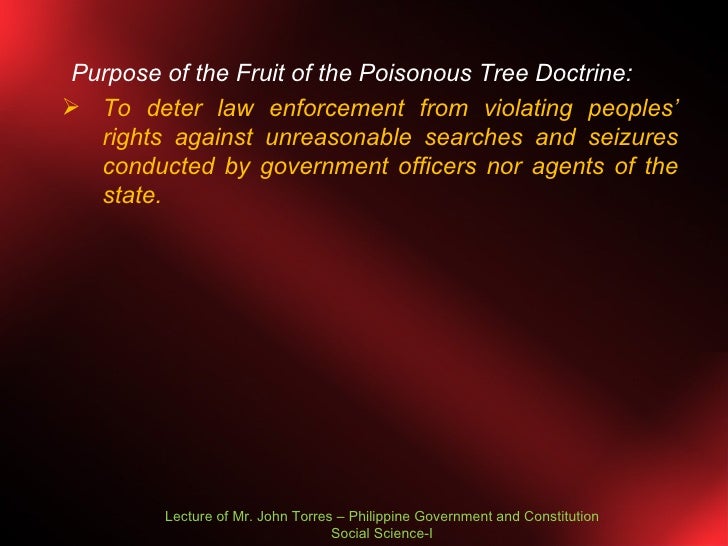
The doctrine was established primarily to deter law enforcement from violating rights. Fruit of the poisonous tree is a legal metaphor used to describe evidence that is obtained illegally. The doctrine was established in 1920 by the decision in silverthorne lumber co. Fruit of the poisonous tree doctrine. Fruit of the poisonous tree is a legal theory in the united states that makes illegally obtained evidence, as well as subsequent evidence legally obtained if discovered solely as a result of the illegally obtained evidence, inadmissible in a court of law. Furthermore, what is the poisonous fruit? Fruit of the poisonous tree. The poisonous tree here is the failure by the police to give any mirandawarnings at all. A doctrine or a legal metaphor? The situation with mueller is that every single thing that has come up or derived from all this russia nonsense is tainted. Tree doctrine to first generation derivative evidence. The legal definition of fruit of the poisonous tree doctrine is bars the admission of physical evidence and live testimony obtained directly or the most frequent application of the fruit of the poisonous tree doctrine comes in the defence application to exclude evidence sought to be used by. The excluded fruit is the unwarned confession.
The doctrine was established primarily to deter law enforcement from violating rights. Many people discuss the effectiveness of exclusionary rule deterring police. This phrase refers to a legal doctrine originating in 1920 with the decision in silverthorne lumber co. Poisonous tree doctrine — doctrine refers to an illegal arrest or search which leads officers to evidence seized in a proper manner that may be inadmissible because of the taint of the original illegality. The doctrine is based on the rule that evidence obtained through illegal search or illegal interrogation taints not only evidence obtained but also facts discovered by the process.
Definition Of Fruit Of The Poisonous Tree Doctrine ... from image.slidesharecdn.com United states, and the phrase fruit of the poisonous tree was coined. In india, the doctrine of fruits of the poisonous tree has no parallel application. Fruit of the poisonous tree is a legal theory in the united states that makes illegally obtained evidence, as well as subsequent evidence legally obtained if discovered solely as a result of the illegally obtained evidence, inadmissible in a court of law. Evidence discussion the doctrine underlying the name was first described in silverthorne lumber co. 4th amendment extends not only to direct evidence in violation but also to ancillary evidence. Fruit of the poisonous tree goes beyond justin's explanation and refers to other evidences which was not found during the illegal search but rather found as a the silver platter doctrine which was ruled unconstitutional in the case of elkins v. The fruit of this poisonous tree is evidence later discovered because of knowledge gained from the first illegal search, arrest, or interrogation. The fruit of poisonous tree doctrine states that evidence obtained from an illegal arrest, unreasonable search, or coercive interrogation is not admissible in a court of law and must be excluded from trial.
It's fruit of the poisonous tree.
The doctrine is based on the rule that evidence obtained through illegal search or illegal interrogation taints not only evidence obtained but also facts discovered by the process. Evidence discussion the doctrine underlying the name was first described in silverthorne lumber co. Fruit is the cocaine in the locker. Ackee fruit is toxic when unripened, containing a poison called hypoglycin. The excluded fruit is the unwarned confession. The doctrine was established in 1920 by the decision in silverthorne lumber co. The first conviction was based on. The logic of the terminology is that if the source (the tree) of the evidence or evidence itself is tainted, then anything gained (the fruit) from it is tainted as well. The complications can best be described as fruits of the poisonous tree. The supreme court first hinted at the fruit of the poisonous tree doctrine in silverthorne lumber co. The fourth amendment brought complication. Many people discuss the effectiveness of exclusionary rule deterring police. Illicit evidence is detailed in the fruit of the poisonous tree doctrine.
Is Bitcoin Sv Dead - Core Coin Is Dead Long Live Bsv Bitcoinsv - The only difference is that, whereas bitcoin has now. . Bitcoin cash can replace every payment system in the world with a better user. The original cryptocurrency has died 90 times in 2018, according to 99 bitcoins. Bitcoin vs bitcoin cash vs bitcoin sv. The plan is to grow the blocks eventually to 1 tb size. Bitcoin is dead (read 2224 times). Bitcoin has crashed but it doesn't seem like the end to me, just a nasty pullback and a delay to the great day bitcoin runs past $20,000. Bitcoin is dead (read 2224 times). Bitcoin stumbles + 2020 price predictions, binance upgrade, bitcoin sv is fake & litecoin adoption. Nevertheless, bitcoin sv is far from being dead. Our ecosystem is based on four pillars that form the basis of bitcoin sv's infrastructure to create the one blockchain for the world. Https Encrypted Tbn0 ...
Best Crypto Staking Platform - Crypto Staking - A Passive Way to Earn Income - CryptoNewsZ : What are the best cryptocurrencies for staking? . This provider offers crypto asset custody for institutions and it supports coins like tezos. And if you are invested in eth, you can essentially help the system flourish by becoming one of its early validators. This platform is best known for starting trades on newer currencies like neo and cardano. That is a genuine demonstration of the interest, popularity, and profitability of staking. It significantly depends on the staking coin you pick, how much you can afford to invest, and what kind of investment platform you have chosen. Binance staking binance is one of the most popular cryptocurrency exchanges with an average daily trading volume of $3.88 billion. The platform has seen a meteoric rise to become the most popular crypto trading exchange with the highest daily trading volume. Tools like cryptocurrency wallets are addin...
Bitcoin Cash Prediction In 2025 - Bitcoin, Bitcoin Cash, and Binance Coin Price Prediction ... / Huobi bitcoin cash hbch price prediction and forecast based on money flows or history of internet and technological companies. . Another crypto price prediction website called digitalcoinprice has predicted that the price of bitcoin cash will reach a maximum price of $550 in 2020 and keep rising to around $1100 by 2025. Another site, smartereum, predicts a much more bullish scenario for the cryptocurrency as it should reach the current 2025 price prediction for bch is that it will get past the $4,000 mark. Even though the introductory passage has some negative connotation to it, we are far from claiming that bitcoin cash is a lost cause. Read bitcoin cash price prediction to stay updated with bch price forecast for upcoming years based on historical price movements and technical analysis. Bitcoin cash price prediction 2025. Another site, smartereum, predicts a much more b...




Komentar
Posting Komentar